
- 作者:纯北
- 来源:镜子超人
- 发布时间:2026-08-26
甜蜜蜜
Trial begins for 3rd officer charged in connection with Elijah McClain's death_我的网站

一 | The second trial in connection with the death of 23-year-old Elijah McClain following an altercation with Aurora, Colorado, police began Tuesday.Nathan Woodyard was the first police officer on the scene in August 2019 and he put McClain in a carotid hold. He has pleaded not guilty to the charges of manslaughter and criminally negligent homicide.Woodyard's legal representatives declined to comment on the case.In opening arguments, Assistant Attorney General Ann Joyce argued that Woodyard's actions on Aug. 24, 2019, led to McClain's death and were not aligned with his police training, according to ABC affiliate Denver7.McClain told officers during their encounter that he was having trouble breathing and he later choked on his own vomit while he was restrained, the previous trial revealed."This trial is about the defendant and his teammates doing nothing to help Elijah McClain. This trial is about their continued callousness and indifference to Mr. McClain's suffering," she said.Attorney Megan Magdalena Downing, who represents Woodyard, argued that the ketamine that was administered by the EMTs that night was responsible for McClain's death, according to Denver7."Let me be clear — someone is guilty," Downing said. "They're not here. It's not Nathan."McClain was stopped by police on his way home from a convenience store in August 2019. A passerby called 911 to report McClain as acting "sketchy" with a ski mask on; however, the caller said there was no weapon and that no one was in danger at the time.McClain was wearing a ski mask at the time because, according to his family, he had anemia, a blood condition that can make people feel cold more easily.When officers arrived on the scene, they told McClain they had a right to stop him because he was "being suspicious."In police body camera footage, McClain can be heard telling police he was going home and that, "I have a right to go where I am going."Woodyard placed McClain in a carotid hold and he and the other two officers at the scene moved McClain by force to the grass and restrained him.McClain can be heard pleading with officers in police body camera footage, saying he can't breathe correctly."I'm so sorry. I have no gun, I don't do that stuff. I don't do fighting. Why are you taking me?" McClain can be heard saying in body camera footage."I can't breathe," McClain said, according to the body camera footage. He echoed these words several times.When EMTs arrived at the scene, McClain was given a shot of 500 milligrams of ketamine for "rapid tranquilization in order to minimize time struggling," according to department policy, and was loaded into an ambulance where he had a heart attack, according to investigators.McClain was declared brain-dead days later and died on Aug. 30, 2019.McClain's cause of death, which was previously listed as "undetermined," was listed in an amended autopsy report as "complications of ketamine administration following forcible restraint." The manner of death remained listed as "undetermined" as it was in the initial report.In the first trial in connection with McClain's death, officer Randy Roedema was found guilty of criminally negligent homicide and assault in the third degree last week.Another officer, Jason Rosenblatt, was found not guilty on charges of reckless manslaughter, assault in the second degree, and criminally negligent homicide.McClain's mother, Sheneen McClain, walked out of the courtroom with a raised fist after the split verdict and said she was not satisfied with the outcome."America needs to start telling the truth about its history and changing the way it treats all the people that pay into its systems of control," she said in a statement to ABC News on Friday. "Don't say sorry to me for humans that fail even their own kind. My soul still cries out for divine justice for my son Elijah McClain."。
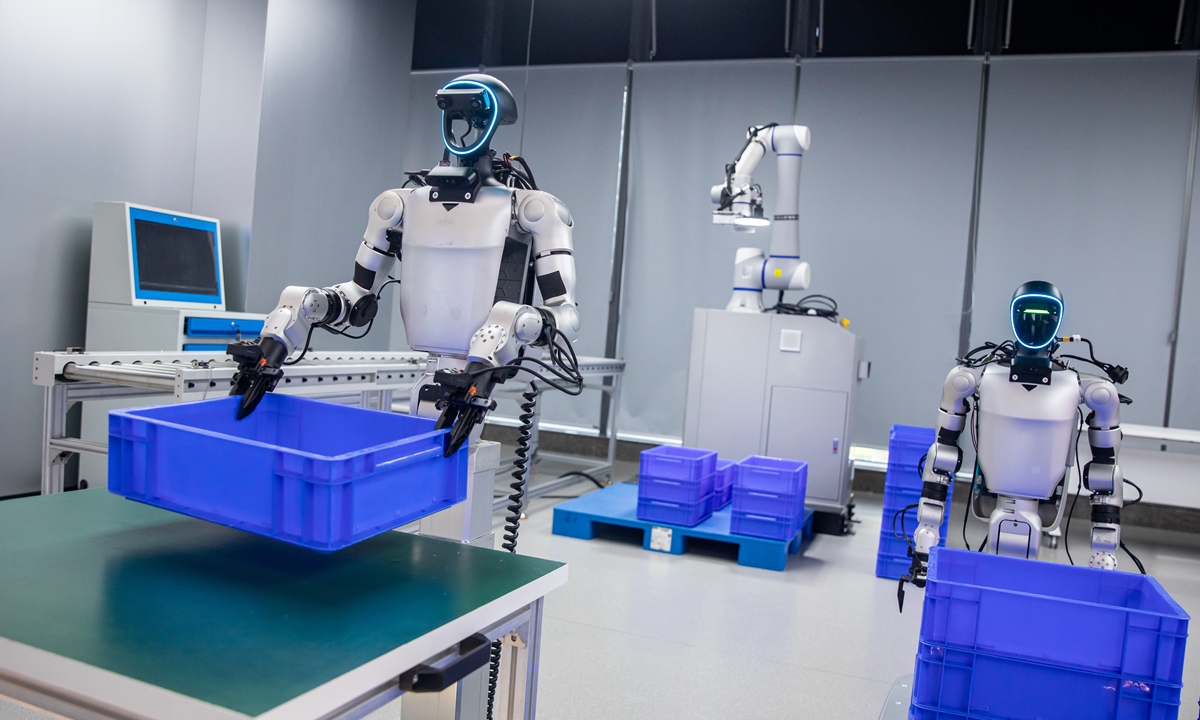
Consumer-oriented embodied AI model developer Noin Intelligence announced a 500-million-yuan ($74.1 million) Angel++ funding round on Monday, the company said in a statement, marking another major capital inflow into embodied AI models as investors turn their attention toward the "brains" behind robots.
According to the statement, the company plans to channel the funding into developing more generalizable embodied AI models, advancing iterations of its GLOW generative model, and accelerating product validation and mass production.
Industry experts noted that a broader shift in the robotics race, with competition moving beyond hardware performance toward the development of core intelligence capabilities. While hardware forms the physical foundation of robots, embodied AI models determine their ability to perceive, learn, reason and adapt in real-world environments, making them a key factor in unlocking future opportunities.
The funding momentum extends beyond Noin Intelligence, with several other companies recently securing major financing rounds that are largely focused on advancing their AI models.
On August 3, Wuxi-based embodied intelligence company DISCOVER Robotics secured a $100 million Angel+ funding round, shortly after completing its initial angel financing of more than $100 million, according to Wuxi Fabu, the official WeChat account of the local government.
The company later introduced ORION, a hierarchical embodied intelligence foundation model, as well as LOOP, a virtual-real hybrid data closed-loop system, and DISCOVERSE, a high-fidelity simulator. The solutions are designed to tackle two major challenges facing the embodied intelligence — data scarcity and limited generalization — and accelerate the development of more capable AI systems, according to Wuxi Fabu.
In addition, according to industry media reports on August 3, Ant Lingbo, Ant Group's embodied intelligence subsidiary, has launched its first round of financing, seeking to raise 1.5 billion yuan.
The company aims to complete a second funding round by the end of this year. The company later confirmed to media that it was in discussions with investors, saying that as a core initiative of Ant Group's embodied intelligence strategy, it will continue to focus on developing general-purpose robotic brains, increase investment in embodied-native technology pathways, and accelerate industrial deployment.
The shift is also reflected in the fundraising priorities of publicly listed candidates.
Notably, Unitree Robotics, which has recently drawn widespread attention from the capital market, officially opened IPO subscriptions on Monday. According to its prospectus registration document disclosed by the Shanghai Stock Exchange on June 2, the company plans to raise 4.202 billion yuan through the IPO, with nearly half of the proceeds earmarked for its intelligent robot model R&D project.
Of the total proceeds, 2.02 billion yuan will be allocated to the intelligent robot model development project, significantly exceeding the 1.11 billion yuan planned for robot body R&D, highlighting the company's focus on developing the AI capabilities that power robots.
Wang Peng, an associate research fellow at the Beijing Academy of Social Sciences, said the latest financing trend shows that capital is reassessing where the core value of robotics lies. Investors are increasingly moving beyond robot hardware itself and treating embodied AI models and robotic "brains" as high-value assets, with capital flowing more toward software, algorithms and intelligence capabilities, he told the Global Times on Monday.
The valuation framework is also being reshaped, with investors paying greater attention to real-world deployment, customer adoption and repeat demand rather than hardware specifications or corporate narratives alone. Whether robots can operate reliably in real application scenarios has become a key benchmark for investment decisions, Wang said.
He added that increased investment in embodied AI models and generative world models could help address the structural gap between general-purpose AI models and physical-world interaction by expanding the supply of real-world interaction data. Capital is also increasingly favoring companies aligned with the country's long-term industrial priorities and emerging industry development plans, he said.
According to data from IT industry research platform ITjuzi.com, financing in China's embodied intelligence sector totaled 93.5 billion yuan in the first half of 2026, surpassing 90 billion yuan and marking a fivefold increase from the same period in 2025. The number of financing deals reached 322, up 137 percent year-on-year.
As China enters the first year of its 15th Five-Year Plan period (2026-30), policy priorities are placing greater emphasis on developing emerging industries, with the country accelerating AI development and promoting its integration with various sectors, Chinese experts noted. Meanwhile, as global AI development enters a new stage driven by broader applications and deeper industry integration, embodied intelligence is expected to unlock significant growth potential.
Driven by policy support and rapid industry evolution, the nation's upstream and downstream segments of the AI industry have gained momentum, achieving notable progress.
According to a Bloomberg's Monday report, China's humanoid robot makers commanded more than 97 percent of global shipments in the first half of 2026, according to new industry data affirming the country's early lead against US rivals in the burgeoning field.
Meanwhile, global humanoid robot shipments totaled roughly 19,100 units in the first half of 2026, more than triple the 5,100 units shipped in the same period last year, according to data from Smart Analytics Global. Data further noted the California-based research firm expects shipments to rise to around 60,000 units this year and reach half a million by 2030.
。
Current article:http://e4c2nxb.chengjuecannaobianmouqueduoyu.shop/92s/o0d0x9p.html
Published on:22:01:09
- 本文标签:
- 晓说